
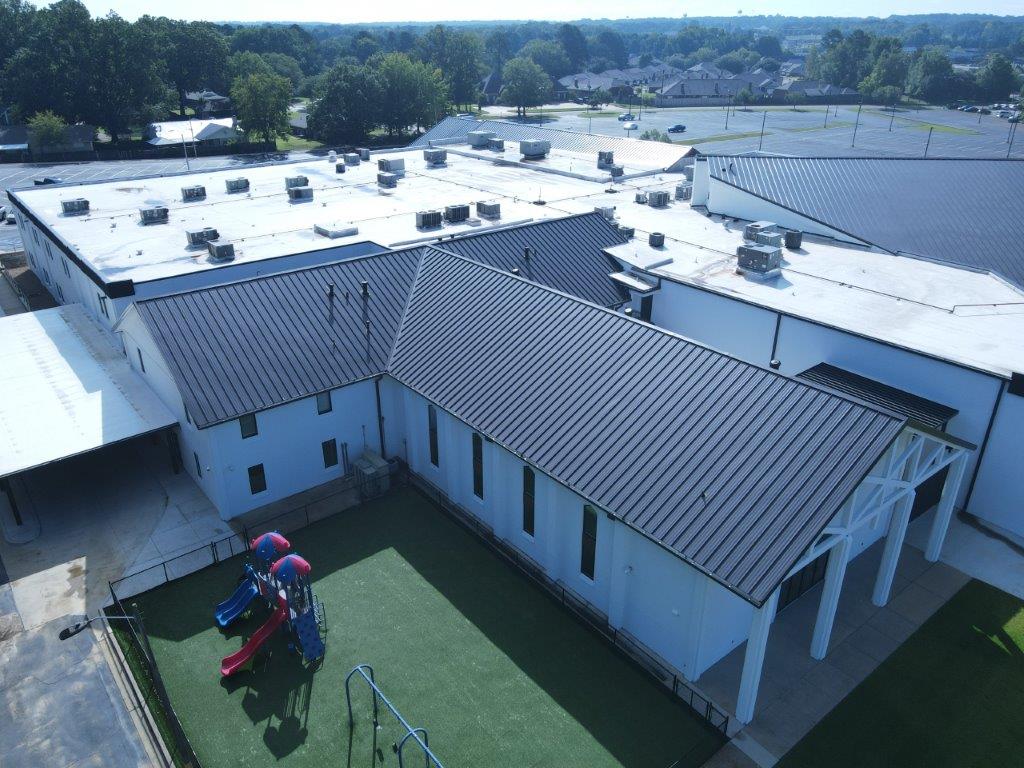
Valley Baptist Church in Bakersfield is one of the largest evangelical congregations in the San Joaquin Valley, its expansive campus and wide clear-span sanctuary roof reflecting the church's decades of growth in Kern County. Bakersfield presents a roofing environment that is extreme even by California standards: summer surface temperatures on flat roofs routinely exceed 170 degrees Fahrenheit, making it one of the hottest roofing environments in the continental United States, while valley fog in the winter months creates prolonged moisture exposure on elevated roof surfaces that contractors who only know the summer climate can underestimate.
California's Title 24 energy code is particularly impactful for Bakersfield churches because of the city's Climate Zone 13 designation, which requires the highest cool roof performance values of any climate zone in the state. This is not merely a compliance technicality-a well-specified reflective TPO or PVC membrane system on a large Bakersfield church can reduce cooling loads by 15 to 25 percent compared to a conventional dark surface system, producing utility savings that compound significantly over the 20-to-30-year life of the new roof. For churches operating on constrained budgets in a region where summer electricity rates are substantial, this represents real and predictable savings that should be factored into the total cost of ownership analysis the building committee presents to the congregation.
Clear-span construction in Bakersfield's mid-century and modern church buildings reflects the Central Valley's preference for single-story, wide-bay structures that maximize interior flexibility. The steel or wood truss systems supporting these large flat decks have generally performed well in Kern County's dry climate, but the decks themselves-often oriented strand board or plywood in 1980s through 2000s construction-can develop localized moisture damage from long-standing leaks that appear as soft spots or delamination when probed during pre-bid surveys. Any re-roofing project on a Bakersfield church over 15,000 square feet should include a systematic deck condition survey, because replacing damaged deck sections during re-roofing is far less expensive than discovering widespread deck failure after the new membrane is installed.
Valley fog, a distinctive feature of Kern County's winter and early spring weather, creates a moisture accumulation dynamic on flat church roofs that condensing climate zones don't produce. Fog droplets collect on horizontal surfaces and drain slowly through systems that were designed for episodic rainfall rather than continuous light moisture. Clogged drains that are merely inconvenient in summer become active ponding sources during Tule fog season. Drain inspection and cleaning before the fog season begins-ideally in October-is a low-cost preventive measure that Bakersfield church facilities teams often defer and subsequently regret.
Steeple and bell tower features on Bakersfield's Baptist, Catholic, and Assembly of God churches have been exposed to decades of intense UV radiation and thermal cycling, and the sealants at steeple base flashings on older buildings should be presumed to have exceeded their useful life without independent evidence to the contrary. Silicone sealant is the appropriate choice for steeple base re-sealing in Kern County's climate because its UV resistance and temperature flexibility significantly exceed those of polyurethane or acrylic formulations that are acceptable in milder California climates.
Scheduling major church roof work in Bakersfield presents a narrow but workable window. Summer temperatures make outdoor work genuinely dangerous-surface temperatures on dark existing roofing can exceed 140 degrees, and workers on the roof face heat stroke risk when ambient temperatures are in the triple digits. The optimal window for Bakersfield church roof work is the six weeks from mid-September through October, after summer heat breaks but before Tule fog season limits visibility and extends drying times. Spring, from March through early May, is the secondary window. Both avoid the peak of the congregation's programming year while providing weather conditions suitable for installation quality.
Capital campaigns for Bakersfield churches have a solid track record in the San Joaquin Valley's faith community, but building committees should be prepared for the reality that Kern County's oil-dependent economy creates volatility in congregational giving that campaigns in more economically stable metro areas do not experience to the same degree. Successful campaigns in this market are typically led by three to five major donors whose commitments anchor the campaign before the broad ask is made to the congregation. Identifying and cultivating those anchor donors before the public launch of the campaign is the single most important capital campaign preparation step for Bakersfield faith communities.
The City of Bakersfield Development Services Department administers building permits for commercial roofing projects within city limits, and Kern County Building Inspection handles unincorporated areas. California Building Code requirements for commercial roof replacements include plan check submittals that document Title 24 compliance, which requires calculating the thermal and solar reflectance values of the proposed roof assembly and confirming they meet Climate Zone 13 minimums. Your contractor should have experience preparing California energy code compliance documentation and should include this in their standard project scope rather than treating it as an add-on service.
- What is the safest time of year to do roof work in Bakersfield given the extreme heat?
- Mid-September through October and March through early May are the optimal installation windows. Summer work is possible with rigorous heat illness prevention protocols, but September and October offer the best combination of comfortable working temperatures, reduced precipitation risk, and availability before fog season limits working conditions.
- Does California's Title 24 apply to our church's roof replacement in Bakersfield?
- Yes. Bakersfield is in Climate Zone 13, which has the most demanding cool roof requirements in the state. Low-slope commercial roofs including church buildings must meet minimum solar reflectance and thermal emittance values. Your contractor's specification must reference CEC-listed compliant products and include the compliance documentation for plan check submittal.
- What causes soft spots or deck damage on Bakersfield church roofs?
- Long-standing leaks-often from failed flashing at parapet walls, HVAC penetrations, or drain collars-allow moisture to accumulate in the insulation and reach the deck layer. In OSB and plywood decks, moisture causes delamination and loss of fastener grip. A pre-bid survey with core cuts identifies affected areas so they can be included in the scope and budget before the project begins.
- How do we evaluate whether a contractor is qualified for our Bakersfield church project?
- Request documentation of current California Contractor's License Board (CSLB) Class C-39 roofing license, manufacturer certification for the specific membrane system specified, and a list of completed California church projects in the past five years. Contact those references directly and ask specifically about the contractor's performance during California's plan check and inspection process.
- What is an NDL warranty and why does it matter for our congregation?
- NDL stands for No Dollar Limit. An NDL warranty from a manufacturer covers the full cost of any covered repair or replacement for the warranty period without deduction, regardless of when in the warranty period the failure occurs. This is substantially more valuable than a prorated warranty that pays a declining percentage of costs as the roof ages-particularly important for a congregation relying on a fixed operating budget.