
Putting solar on a Bakersfield commercial roof is a roofing decision before it is an energy decision
A rooftop photovoltaic array changes everything about how the roof underneath it behaves, and around Bakersfield we see the consequences of that being treated as an afterthought. The sun load here is relentless from late spring through September, the kilowatt-hour math pencils out fast, and building owners along the Rosedale Highway commercial strip, the warehouses off Buck Owens Boulevard near the Marketplace, and the agricultural processing plants lining the Highway 99 corridor are all looking hard at on-site generation. We support that move. But we install and steward the membrane, not the panels, and our first job is to make sure the roof can carry an array for its full service life without becoming a leak factory or a structural problem.
The single most expensive mistake we watch owners make is bolting a twenty-five-year solar asset onto a roof with eight years left in it. When that membrane fails, every module, rail, and ballast block comes off, gets stored, and goes back on - a detach-and-reset bill that routinely runs tens of thousands of dollars on a mid-size warehouse and can dwarf what it would have cost to reroof first. So before anyone signs a solar contract, we core the existing assembly, pull moisture readings, and give you a candid remaining-service-life number. If the roof has fifteen-plus good years, build on it. If it is tired, reroof now and let the solar crew mount to a fresh, warranted surface the same season.
Racking penetrations and the war over where water gets in
Every solar attachment method introduces a roofing problem, and they are not equal. Penetrating, mechanically attached racking drives a fastener and standoff through the membrane at hundreds or thousands of points across a Bakersfield warehouse roof - and each one of those is a potential leak unless it is flashed as a true roof penetration, not a generic rubber boot smeared with sealant. On single-ply systems we want pre-fabricated, manufacturer-approved flashing details welded or bonded into the field membrane at every post. Sealant alone fails under our thermal swings; what holds is a heat-welded target patch or a properly stripped-in base flashing that becomes part of the roof.
Ballasted racking avoids most penetrations by holding the array down with weighted trays or concrete blocks, which is attractive on a low-slope roof - until you weigh it. That is the trade we walk owners through: fewer holes, but a real dead load and a wind-uplift problem that has to be engineered, not guessed.
Weight and wind uplift on flat Bakersfield roofs
Ballasted systems add meaningful pounds per square foot spread across the deck, and a lot of the older tilt-up and bar-joist buildings in east Bakersfield's industrial pockets were never designed with that margin in mind. We will not let an array go up until the added dead load - panels, rails, and ballast together - has been checked against the building's structural capacity by an engineer. Wind is the other half. Bakersfield catches strong gradient winds and the periodic gusty events that funnel down out of the Grapevine and across the open valley floor, and an under-ballasted array can lift, slide, or scour the membrane in a single bad storm. The racking layout has to account for the higher uplift pressures at the roof perimeter and corners, where wind does its worst, not just the calmer field of the roof.
Membrane compatibility and conduit routing we sort out before the solar crew arrives
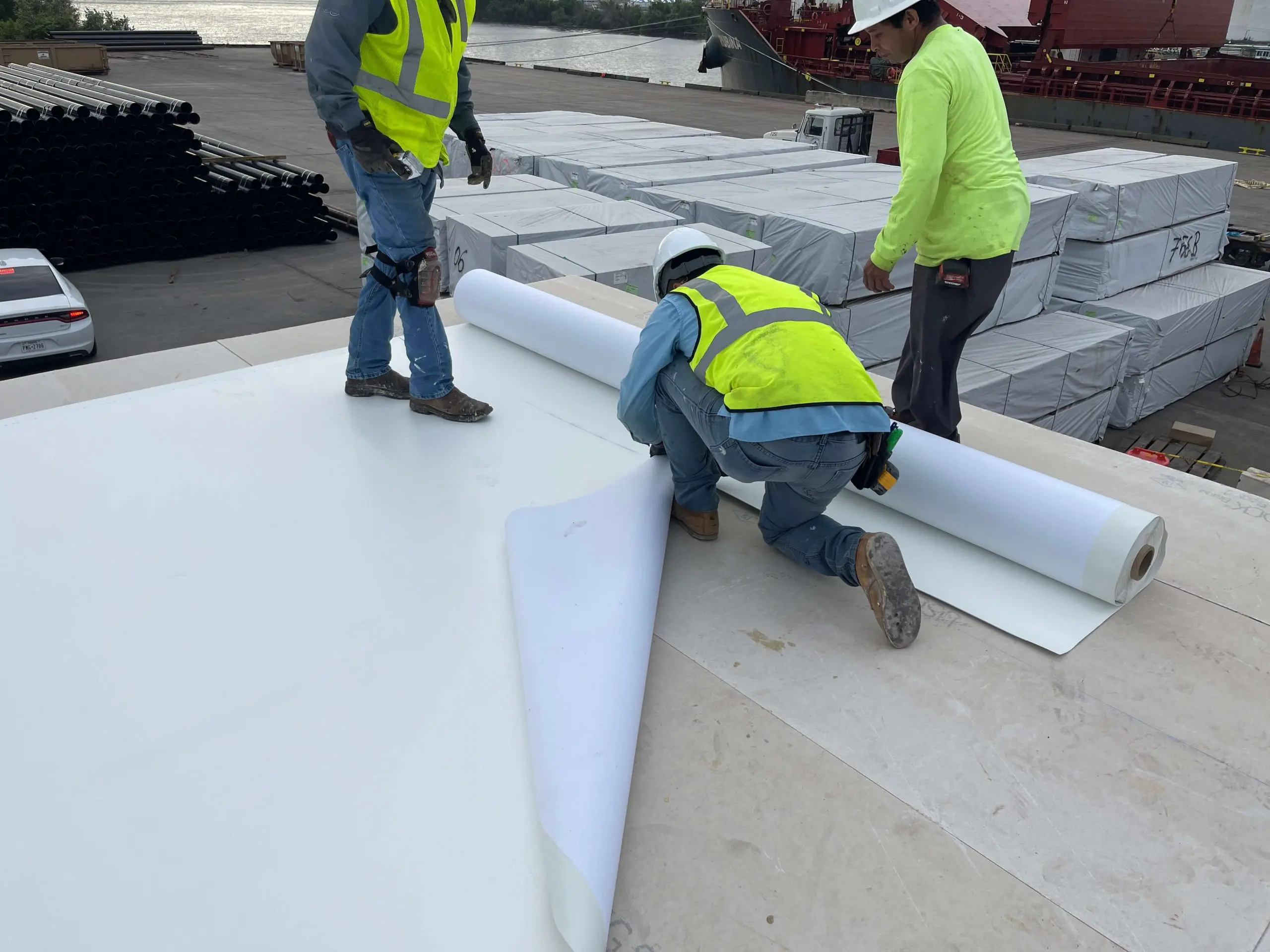
Not every membrane likes everything sitting on it. We favor a reflective white TPO or PVC under an array because the cooler surface helps panel output in our heat and the welded seams give a clean, repairable substrate, but PVC and certain rubber components do not play nicely in contact, and rail feet dragging on a soft membrane will abrade it over years of thermal movement. So we specify protective walk pads and slip sheets at contact points and confirm the membrane chemistry against the racking hardware up front.
Conduit is where coordination breaks down most often. Left to a solar electrician working alone, DC and AC runs get strapped flat to the membrane or punched through with whatever boot is in the truck. We get into the pre-construction conversation early and dictate the rules: conduit rides on elevated, roof-rated supports - never directly on the membrane - and every roof penetration for a combiner, a home run, or an equipment curb gets a roofer-built, warranty-grade flashing before any wire is pulled. Sequencing matters too. The membrane goes down and gets inspected, then penetrations are flashed, and only then does the array land on top.
Coordinating the roofing warranty with the solar installer
This is the piece that protects you for the next two decades, and it is the piece most often dropped. The major single-ply manufacturers will keep a no-dollar-limit membrane warranty in force under a rooftop array - but only if the system is installed to their published solar requirements and, in many cases, reviewed by their warranty representative before installation. The moment an unapproved penetration goes in or an untrained crew welds a patch, that warranty is exposed. We act as the bridge: we register the solar layout with the membrane manufacturer, confirm the approved details, schedule the manufacturer's pre-cover inspection, and make sure the line of responsibility is written down - roofer owns the membrane and the penetrations, solar contractor owns the array and the electrical. When a leak shows up three years later, nobody is pointing fingers, because the scope split was documented on day one.
We do not sell solar systems and we are not trying to. What we offer Bakersfield owners is the roofing judgment that determines whether your solar investment is sound - the assessment, the substrate prep, the penetration work, and the warranty coordination - so the array your solar contractor installs is sitting on a roof built to carry it.