
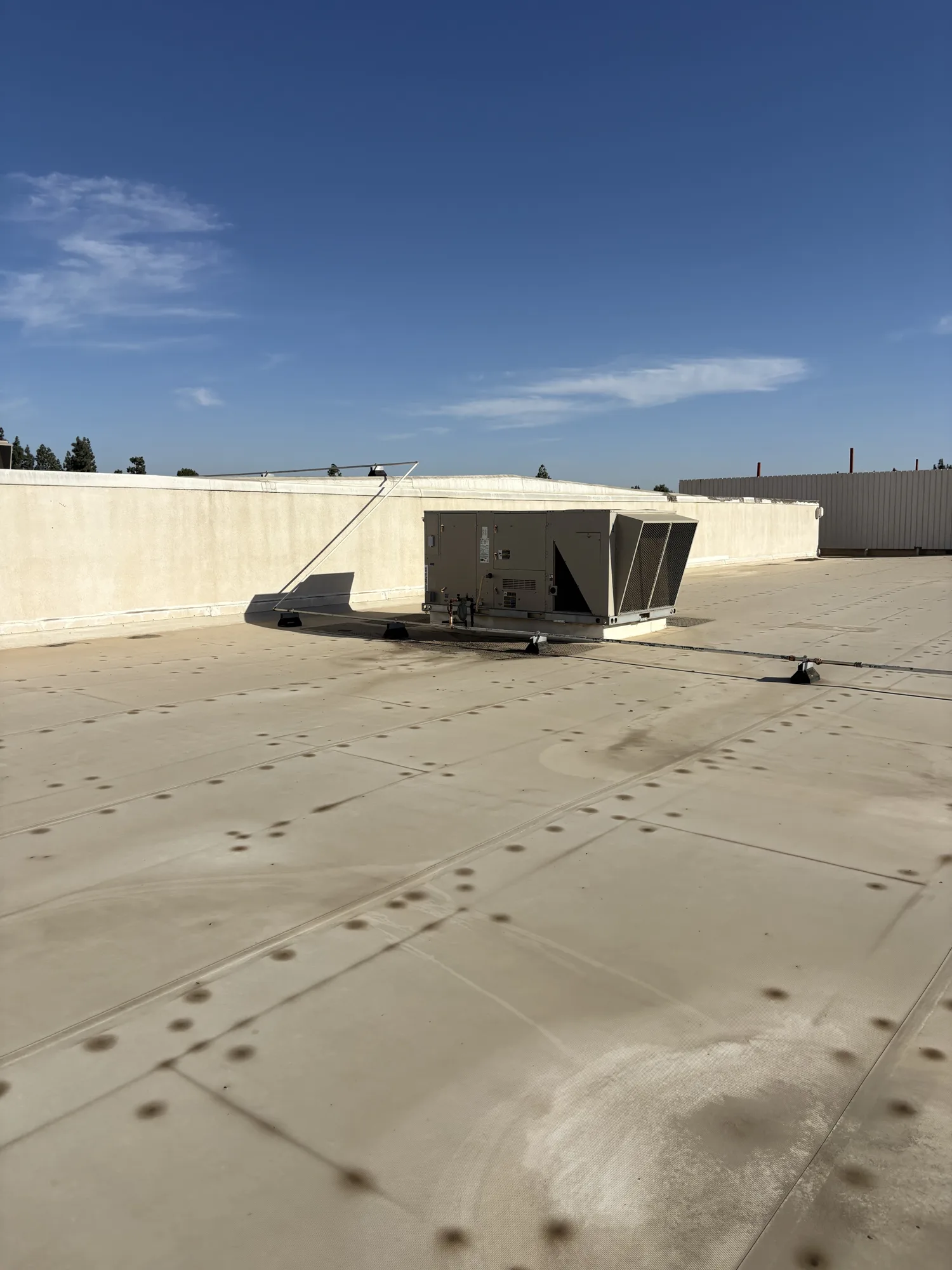
Weathered existing TPO documented during a Bakersfield site visit before repair. Shown for condition assessment; the photo does not establish the cause of damage.
Kern County's signature roof peril is not hail - it's wind. The San Joaquin Valley funnels sustained gusts and short, sharp windstorms across open agricultural land straight into the industrial and warehouse districts along Rosedale Highway, the Seventh Standard corridor, and the Highway 99 spine. A flat commercial roof with a mechanically attached membrane and an aging edge detail is exactly what that kind of wind event finds first.
We're your roofing contractor, not a public adjuster - we document and substantiate the roof damage so you and your adjuster work from an accurate scope. On a wind-damaged roof, that means getting up there quickly, mapping exactly where the membrane lifted or tore, and recording the conditions that explain why.
How Valley Windstorms Damage a Commercial Roof
Wind damage on a low-slope roof concentrates at the edges. Parapet corners, perimeter fastening patterns, and coping joints take the highest uplift pressure, and that's where we typically find torn seams, creased membrane, or coping sections that have worked loose. On older mechanically attached systems, a single failed fastener line can let wind get underneath the membrane and peel back a much larger section than the visible tear suggests - which is why we check field membrane adhesion several feet past any obvious damage rather than the torn area alone. Rooftop equipment curbs and their flashing are another common failure point; a unit that has shifted even slightly on its curb usually means the flashing seal broke first.
Atmospheric-River Rain and Drainage Failure
Bakersfield's rain arrives in bursts, usually tied to Pacific atmospheric-river systems that can drop more rain in a day than the roof sees in the rest of the season combined. On a roof already carrying wind damage - a lifted seam, a cracked pipe boot, a compromised parapet joint - that volume of water finds the opening fast. We check whether drains and scuppers were clear before the event, whether the water pattern inside the building matches the wind-damage location on the roof, and whether ponding after the rain points to a drainage design issue separate from the storm itself. That distinction matters for the claim file: storm-caused water intrusion through wind damage is a different claim than chronic ponding that happens to show up worse after a big rain.
Wind-Driven Dust and Debris
Dust events off the southern San Joaquin Valley floor are a regular part of Kern County weather, and wind strong enough to move agricultural dust across Highway 99 or Highway 58 is also strong enough to move roof debris. We look for abrasion on coated or granulated membranes where grit has scoured the surface, drains and scuppers packed with fine sediment, and gravel or loose ballast material that has migrated or been carried off the roof entirely. These are lower-drama findings than a torn membrane, but they matter for the claim because clogged drainage from the same wind event is often what turns a contained leak into standing water damage.
Hail, When It Happens
Hail is a less frequent event in this part of the Central Valley than wind or rain, but it does occur, and when it does we fold it into the same inspection. Hail bruising shows up as soft, circular depressions on coated single-ply or modified bitumen membranes, cracked or pitted skylight domes, and dented metal on edge trim, gutters, and rooftop equipment housings. Because hail damage can be subtle on a membrane roof - easy to miss without close inspection - we walk the field systematically rather than spot-checking, and we photograph impact patterns against a scale reference the same way we would for wind damage.
Documenting the Full Event
A single storm can produce wind, rain, and dust damage on the same roof, and the claim file should reflect that instead of treating it as one generic "storm damage" entry. We separate findings by mechanism - wind uplift here, water intrusion there, abrasion elsewhere - with photos, measurements, and notes tied to each. That level of detail is what lets an adjuster, or ownership's public adjuster if the claim needs to go further, argue the scope accurately instead of guessing at what a general description covers.
If loose metal, an open seam, or an active leak is putting the building at risk right now, emergency tarp and dry-in work can stabilize the roof before the full claim inspection happens - we don't wait on paperwork to stop water from getting further into the building.